The Snowboard Bindings Buyer's Guide: How to Choose the Right Pair?
The Snowboard Bindings Buyer's Guide: How to Choose the Right Pair?
Howdy, adventurers! You have spent hours poring over board profiles. Maybe you have even tried on dozens of boots to get a snug fit.
But what about the snowboard bindings that connect your body's energy directly to the board beneath your feet?
Snowboard bindings translate every subtle shift of your weight and every thought in your brain into immediate action on the snow. A cheap or mismatched binding will mute your board's responsiveness. It will make strapping a miserable chore, and frankly, wear you out faster.
The global binding market is now projected to continue expanding around 8% annually through the next decade. With winter sports participation, innovation is also at an all-time high.
Bob's Sports Chalet is here to cut through the jargon. This blog post will cover everything so you can choose the best snowboard bindings from their vast collection.
How Snowboard Bindings Affect Your Snow Ride?
The primary job of a binding is simple. It is to secure your boot to the board. But the mechanism through which it achieves this determines your entire on-snow experience.
The better your binding is at energy transfer, the less work you have to do to make the board respond.
A well-designed binding makes sure that when you lean forward, the pressure instantly transfers to the toe edge. When you lean back, the highback catches your calf. Without this instantaneous communication, there is a loss of control and unnecessary fatigue.
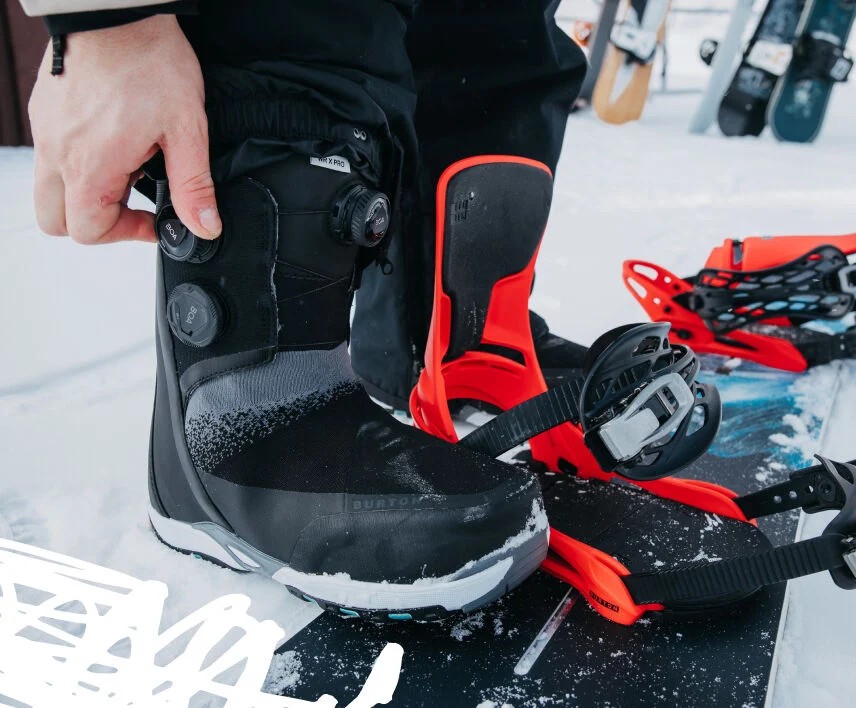
Snowboard bindings are constructed of 3 main components:
- Baseplate mounts to the board and holds everything together.
- Highback is the vertical support that cradles your calf for heel-side leverage and control.
- Straps (Ankle and Toe) to lock your boot down securely to the baseplate.
Strap-In vs. Speed-Entry Snowboard Bindings
The classic two-strap binding was the only game in town for decades. All because of its reliability and adjustability. But let's be honest! Kneeling in the snow to ratchet up straps is the least glamorous part of snowboarding.
The more recent quick-entry systems are now preferred by most riders and resort rental fleets.
The Classic Strap-In Binding
The standard two-strap design remains the gold standard for high-performance riding. These bindings use a flexible ankle strap and a toe cap strap.
When ratcheted down correctly, these provide unparalleled foot hold and energy transfer. You can also adjust strap tension as well as highback lean and highback rotation. They work with almost any snowboard boot and mounting pattern.
If you are a hardcore rider who demands absolute precision and doesn't mind the time it takes to strap in, the classic design is for you.
Step-In Systems
Burton's Step On system is the most famous example. These bindings eliminate straps entirely. They lock your boot directly to the board via three connection points. That too, with a simple click.
They are lightning fast and extremely convenient. Yet they require proprietary Step On boots. So your boot choice is pretty limited.
Rear-Entry Systems
Brands like Flow and Nidecker feature a Supermatic system. They utilize a highback that tilts down. You slide your boot in from the back and flip the high back up. Then one lever locks you in.
Its fast entry works with standard snowboard boots. But the fit can sometimes feel less tailored than a two-strap. They are also heavier due to the locking mechanism.
Hybrid Fast-Entry
Brands like Rome have partnered with FASE technology to create these exciting snowboard bindings. They come with the feel and precision of the classic two-strap bindings. And they also feature a quick entry/exit mechanism. The only trade-off is their higher price tag.
Check out our latest snowboard bindings in stock.
What Flex Rating Should You Choose for Your Snowboard Binding?
Just like snowboards, its bindings have a flex rating as well. The scale runs from 1 (softest) to 10 (stiffest).
Soft Flex
They have a more pliable baseplate and a lower highback for maximum lateral movement. These are the best snowboard bindings for beginners and freestyle riders.
A soft binding is highly forgiving for a beginner learning edge control. If you make a small mistake, the binding flexes immediately. Go for medium-soft flex options like the Nitro Talent or the Union Flite Pro. These offer enough dampening and control to progress without being overly aggressive.
Medium Flex
These are the all-mountain snowboard bindings. Most recreational riders and advancing intermediates will be happiest in a medium-flex binding. They offer robust heel-to-toe control without requiring professional-level strength or focus.
Stiff Flex
Stiff bindings are precision instruments. They feature rigid baseplates with minimal padding and tall highbacks. These are built for pure energy transfer at high speeds. Every millimeter of pressure you apply is instantly transferred to the board's edge.
The downside is zero tolerance for error. Even a minor mistake will cause dramatic falls.
What Materials Make the Best Snowboard Bindings?
You have probably noticed the price difference between a $150 binding and a $500 binding. The materials are what determine that cost.
The Standard Nylon and Fiberglass Composites
The majority of the best snowboard bindings use a blend of nylon and fiberglass for the baseplate and highback. They offer durability as well as a superb balance of flex and dampening.
Different ratios of nylon and fiberglass allow manufacturers to tune the flex precisely. More fiberglass equals a stiffer and snappier response.
This category is also where we see the emerging trend toward sustainability. About 15% to 20% of brands are now integrating recycled plastics or bio-based polymers into their non-load-bearing components.
The Premium Carbon Fiber Snowboard Binding Technology
If you are a performance-oriented rider, you have heard the hype about carbon fiber. It's no myth. Carbon fiber is up to five times stronger than steel but much lighter than traditional materials.
When integrated into the highback and baseplate, it creates a binding that is lightweight yet incredibly stiff. Take the high-end Rome Katana Pro as an example. The rigidity of carbon fiber also enables instant responsiveness.
While amazing, carbon is not perfect for everyone. Because it is so stiff, carbon is less effective at absorbing high-frequency vibrations on hard snow. Your boots and legs end up absorbing most of it as fatigue. Also note that carbon is not elastic. It can suffer brittle fractures under sudden loads.
All in all, carbon fiber is best suited for experienced riders. The ones who demand maximum response and are willing to sacrifice a small degree of dampening.
How Do You Know If Your Bindings Are Compatible with Your Board?
There are four main mounting systems on the market. So you need to choose the binding that matches your board. A lot of purchases get complicated by snowboard binding compatibility.
Always double-check before you buy!
-
4 x 4 / 2 x 4
This one is the standard insert pattern and is used by almost every major manufacturer. The binding disc can be mounted in multiple positions.
-
The Channel
This slot system allows for infinite stance width and angle adjustments. Burton's Re:Flex bindings are made particularly for this system. Though many other brands offer a disc that is compatible with it.
-
3D Pattern
It is an older pattern using three screws. You will need a special binding disc designed for 3D compatibility.
-
Splitboard
Bindings for splitboards require specialized interfaces to connect the two halves of the board. Spark R&D splitboard bindings are the perfect example.
Bob's Sports Chalet makes snowboard binding compatibility easy. Shop now!
Which Features Define Premium Snowboard Bindings?
Once you have the core decisions locked in, it's time to look at the details that separate good ones from the best snowboard bindings.
Canted Footbeds
Look for this feature if you suffer from knee or ankle discomfort. A canted footbed means the baseplate is angled. It will push your knees slightly inward to align them naturally with your hips and ankles. You will experience much less fatigue when riding bell-to-bell in comfort.
Dampening and Cushioning
The best snowboard bindings mostly include EVA foam or rubber padding layers between the baseplate and the footbed. This material absorbs high-frequency vibrations and provides cushioning for hard landings.
Tool-Free Adjustment
Premium bindings allow you to adjust strap length, highback lean, and highback rotation without needing a screwdriver. This customizability is offered by top brands like Rome and Union. They come with easy-to-use levers or screws that you can manipulate with your fingers.
Final Thoughts
Choosing the best snowboard bindings is a decision that impacts everything you do on the mountain.
For the beginner, we always recommend starting with a medium-soft flex in an all-mountain snowboard binding. As you progress, you can move up the flex scale and look at high-tech materials.
Come visit us at Bob's Sports Chalet, your one-stop shop for all things snowboard. We are always here to help you match your dream set of boots and board to their perfect bindings!


